
Transfer Roundup (So Far?) and Depth Chart
Taking stock of DC United's evolving roster on the eve of training camp

Players are going to report to training camp starting tomorrow, so it’s a good time to run through some quick takes on the roster moves I haven’t written about yet, then go over the roster as it currently stands and attempt a depth chart. I say quick takes, but this turned into a monster article. Whoops. Well, there’s no editor to make me cut things and thankfully no ads either, so no reason to split things up into a bunch of smaller posts. We’re just going big today.
But first, here’s links for what I’ve already covered:
End of roster decisions (this is just my preview, but things played out as I expected except for retaining Tubbs so I didn’t end up doing a separate review article)
Options exercised: Conner Antley, Caden Clark, Jackson Hopkins, Hosei Kijima, Gabriel Pirani, Garrison Tubbs
Options declined: Christian Benteke, Derek Dodson, Kristian Fletcher, Randall Leal, Rida Zouhir
Free agency departures: Luis Barraza, Lukas MacNaughton
Drafting Nikola Markovic, Richie Aman, and a couple other players in the 2026 draft
That still leaves plenty of important moves to discuss.
Trade: $350,000 GAM to the New York Red Bulls for Sean Nealis

Sean Nealis was drafted by the Red Bulls back in 2019 and has started 144 MLS games for them, including 20 last season. He’ll be 29 when the season starts. At first glance, getting a guy like this seems like an incredible bargain. He’s a starting MLS centerback, he’s often been the captain of the Red Bulls when guys like Forsberg weren’t available, he’s got a few years left in his prime, he hasn’t had major injuries, and his salary is only slightly higher than Lucas Bartlett’s.
These days $350K GAM isn’t much for a starter, but from what I can tell, he’s become a bit of a distressed asset. Red Bull fans like him on the whole but aren’t too sorry to see him go. They think he’s average at best, and given they missed the playoffs, they’re hoping for upgrades. Nealis has only one year left on his contract, so either DC only gets him for one year before free agency or he signed a new contract when he came, presumably for a bit more money.
But the biggest issue is that after years of playing a high energy, pressing style throughout their multiple clubs, the Red Bulls are transitioning to a more possession-oriented scheme. Apparently, Nealis shines in a system that plays aggressively and with a high defensive line, but that’s no longer how the Red Bulls want to play. And with the overall fashion in MLS shifting toward a possession style, there might not have been many teams even theoretically interested.
For good or for bad, DC is still trying to play the high energy, pressing style that the Red Bulls pioneered and Philadelphia has continued to use to great effect. It’s a bit nerve-racking that DC is still trying to shift to this when even the Red Bulls are moving on, but hey, taking the road less traveled in the league is how you get bargains like a starting centerback for $350K in GAM.
Meanwhile, this trade made sense out of the previous rumor that Lucas Bartlett was antsy and wanting a trade. With the arrival of Nealis, if Rene Weiler wants to play with only two centerbacks, that could leave Bartlett on the bench. We’ll see what happens there, but I don’t think teams are going to be lining up for someone from one of the league’s worst defense last season.
Anyway, Nealis isn’t a worldbeater, but in the system DC will use, he’s probably the best centerback on the roster. As a Wooden Spoon team, DC clearly needed a higher floor and Nealis should help raise it. He doesn’t do much to the ceiling, but in my opinion, it’s best not to spend a ton of money on the centerback position, especially on a team like DC that needs so much help farther up the field.
Signed: Keisuke Kurokawa

Keisuke Kurokawa is a 28 year old left back who has played his entire career up to this point for Gamba Osaka. This is an unusual move. There aren’t many Japanese players in MLS, and while DC has one already in Hosei Kijima, that was a weird situation where Kijima came to the US in high school.
Sogut’s press release quote about the signing was unusually specific:
Keisuke is a dynamic left back with excellent defensive awareness who creates chances in the final third, adding another attacking threat. His ability to push forward and high work rate align perfectly with the identity we are building at the club. He will be an excellent addition as we continue to bolster the squad ahead of the 2026 season.
Sounds great! But…attacking threat? In 32 games’ worth of minutes last season, he had two goals and two assists, and despite four full seasons as a starter he’s never had more than 4 goal contributions in a season. For most of that time Gamba Osaka wasn’t great, but they weren’t terrible either. And while opinions vary about how the level of the J.League compares with MLS, it’s not an obvious step down that would lead you to expect a big increase in production.
It seems more likely that “high work rate” is what they are after, so as long as Kurokawa can still deliver that as he nears 30, that’s probably all right. René Weiler was coaching in the J.League just as Kurokawa was breaking through into Osaka’s starting lineup, so perhaps he remembered being impressed with him.
Normally it’s not worth engaging in deep literary criticism of the press release quotes, but in this case it seemed necessary because the question everyone had about this move was: what about the international left back already on the roster, David Schnegg?
The downside of slowly writing this article is that I wrote a lengthy discussion about the hypothetical merits of having both Kurokawa and Schnegg, but more recently we’ve learned Schnegg has been waived. I’ll write about that separately below, but that clears up the intentions: Kurokawa is clearly meant to be the new starting left back.
The only remaining question is how much they are investing in him. The salary won’t be made public for a while. The only source I can find on J.League salaries seems to indicate Kurokawa was making $30,000 a year in 2021. Hopefully that rose as he became the starter, but it seems like median pay in the J.League is well below MLS. DC’s press release doesn’t mention TAM, but Kurokawa signed a new deal that I assume puts him in the Kye Rowles / Peglow zone of mid-six figures.
But is his salary the only factor? When the signing was announced, I had the impression his contract at Osaka was up and he’s coming on a free transfer. If so, it seems like it could be a tidy piece of business. But some articles about the move claim DC paid a $1.1 million transfer fee for him. DC’s press release didn’t say anything about that, but it doesn’t say he’s a free transfer either.
I don’t know. $1.1 million seems like a high price to pay for a player like this, but DC paid about $2 million to get David Schnegg from the Austrian Bundesliga, so I guess it’s not out of the question.
Sale: Boris Enow
For some reason DC United didn’t admit this happened until I was getting ready to click post on this article, but over a week ago Beitar Jerusalem announced their purchase of Enow with a highlight video and then had him walk on the field to say hi to fans.
Anyway, this is amazing.
Although many players underperformed their contracts last season, there wasn’t really anyone guaranteed through 2026 who had a completely insane number of the Martín Rodríguez or Mohanad Jeaze variety. Boris Enow was only making about $600K, but the cap hit from the $2.2 million transfer fee they paid for him meant he was taking a decent chunk of cap space and not providing much on the field to show for it. René Weiler seemed to play him as little as possible.
I thought he was a good candidate for a buyout, assuming DC’s ownership is willing to use them. Well, Sogut managed to sell him back to the league he came from, reportedly for a little over $500K. The team is taking a big loss, but he’s off the books. I think. I admit I don’t really know how this impacts the amortization of the transfer fee. He’d played a season and a half of a three and a half year deal, so it’s possible there was still more of the fee hitting the cap than the money coming back would cover.
As usual, the workings of the MLS salary cap are arcane and opaque. What we can say, though, is that the team has moved on from Enow and still has two buyouts available. Moving Enow might actually be addition by subtraction, but so far the midfield has gone conspicuously without reinforcements. Hopefully more news is coming.
Free Agent Signing: Sean Johnson

Sean Johnson will be turning 37 during this season, so by soccer player standards he’s quite old, but not prohibitively so for a goalkeeper. He has obviously been brought in to be a stopgap starter; his contract is only guaranteed through this season and the 2027 “sprint season” prior to the calendar switch.
Goalkeeping is a position where there’s an advanced stat that theoretically quantifies the most important part of it, shotstopping, and Johnson turned heads last season by putting up league-leading shotstopping numbers for Toronto. That’s great, but having tracked this data closely last season, my conclusion is that the either shotstopping is an inherently unstable quality from game to game and season to season or else the data simply isn’t good enough to accurately measure it. Maybe both.
Here’s Johnson’s shotstopping (technically, post-shot expect goals allowed minus actual goals allowed) going back to 2018, the first season we have public advanced stats for MLS:
I would love for someone to ask him if he thinks he really played terribly in 2023 and then got much better by 2025 and if so, what caused the decline and then improvement. It’s not impossible he got over some nagging injuries or meditated under a tree and had an epiphany, in which case great, he’ll turn in another dominating season for DC. More likely, we’ll get a reversion toward the mean.
And you know what, that’s fine. That’s more than fine, in fact. It’s worth paying for. DC’s goalkeepers managed -0.19 goals prevented per game last season, meaning DC theoretically gave up over 6 goals more than they would have with average MLS goalkeeping. And by average, that’s mean, not median. Only 10 teams were even below zero in this stat so it is worse than it sounds. Sean Johnson’s worst season since 2018 is considerably better than DC last year.
Now in truth, DC’s 2025 numbers were pushed a lot lower due to Kim Joon Hong (-0.28) and Jordan Farr (-0.54, mostly from being on the field when they got blown out by Philly). Luis Barraza was “only” -0.11, so technically better than Sean Johnson’s worst season.
One big problem with these numbers is that from what I can tell, goalkeepers with a terrible defense in front of them put up worse shotstopping numbers. Maybe because they are hung out to dry, or maybe the data is just bad and giving up more goals makes you look worse. DC’s defense was one of the worst in the league last year, so no one was going to look good. Sean Johnson’s worst season just happens to coincide with Toronto having the second-worst defense in the league. Last season, his numbers were amazing, but despite terrible results, Toronto’s defense was actually pretty good.
Luis Barraza was brought in last season as a floor raising veteran backup, and that’s exactly what he did. Both the advanced stats and my eyes say he was better than Kim. Sean Johnson, barring a sudden age- or injury-related decline, raises the floor a lot further. Here’s another view of Sean Johnson’s shotstopping since 2018, now compared directly against DC’s squad shotstopping in the same years:
Oof. Just one year when DC was better, Tyler Miller’s “all-star” season. Miller was actually quite bad in this stat (-0.14) but Alex Bono was amazing in limited minutes (0.28). Next season Bono was poor in a full season of games (-0.11) so that wasn’t predictive.
Now you might think it’s cheating a bit I used DC’s squad number instead of just whoever the #1 goalkeeper is for that comparison, but something in Johnson’s favor is that he’s very durable. He started 31 games last year, and his career fewest starts in the 15 seasons he’s been a goalkeeper was 20 starts in 2023. Like most DC fans I still think Bill Hamid was better than Johnson back when they were the hot young American goalkeepers, but boy, absolutely no comparison in durability or longevity.
Another benefit is that Sean Johnson has been consistently praised for his locker room presence. It’s widely thought, for example, that Gregg Berhalter brought him to the 2022 World Cup for that reason.
Finally, because Johnson has been in the league for so long, he provides an opportunity to engage in one of my favorite pastimes on this newsletter: naming some old DC United players. Johnson first started playing for Chicago in 2010, but didn’t play against DC United until 2011. That first game was August 28th, 2011. DC tied Chicago 1-1 on a Josh Wolff goal assisted by Santino Quaranta. Other DC players on the field included Clyde Simms, Dwayne De Rosario, Chris Pontius, and an 18-year-old Andy Najar, already in his second season. Bill Hamid was in goal, of course. Did you know Bill Hamid is two years younger than Sean Johnson? Sigh.
Waived: David Schnegg and Dominique Badji
As I post this, the latest breaking news is that Schnegg and Badji have been put on waivers. The fact that they went on as a pair suggests to me that the team will use its two 2026 buyouts on whatever part of their cap hit doesn’t end up getting picked up by another MLS team. It’s too soon to know if anyone has taken them off waivers. One way or another I think either could end up on a different MLS team.
That Badji was on the chopping block isn’t a surprise. His signing made some sense as the closest DC could get to having a backup forward who could play like Christian Benteke. When Benteke was rested or injured, Badji could come in and sure, it would be a big step down, but the rest of the team could play the same way. There ended up being two big problems with this. One is that while Badji was as close as you could get to Benteke with a backup, that really, really wasn’t very close. The even bigger problem is that the team moved away from the hoof-it-to-Benteke-and-hope game model after 2024, so Badji ended up being a player who had all of Benteke’s weaknesses in Lesesne’s pressing-and-possession scheme but none of Benteke’s compensating firepower. Badji scored one goal in 2025 but only ended up with 8 games of minutes despite Benteke missing a lot of time with injury.
David Schnegg is a bigger surprise. No DC United player was on the field for more minutes than Schnegg last year. Fan opinion varied but I think was mostly positive. He seemed like a nice guy who was happy to be in MLS, he always put in lots of effort, and occasionally he pulled off absolutely amazing dribbling moves. But he had a lot of very mediocre performance and was ponderous in defense, which is a problem in a league packed with expensive DP wingers.
I went to refresh my memory and for all the time I spend on stats for this newsletter, even I was surprised that Schnegg’s stats for 2025 were 0 goals and 1 assist in 30 games worth of minutes. Ouch. And here I was criticizing Kurokawa for 2 goals and 2 assists in 32! Somehow I hadn’t realized there was so little end product. His passing completion percentage was the worst of any regular starter besides Benteke, worse than all the attackers who are expected to turn the ball taking risks over in the final third.
Although he’s Austrian, I think Schnegg is kind of a throwback to what American players used to look like in the late 90s and early 2000s: he’s big, pretty fast but not quick, and worked best running a straight line and putting in crosses. Like American players in those days, he came to the game of soccer quite late, so his technical ability was shaky. Last season I felt like he lost more balls out of bounds than any MLS player in the last decade, though there’s no stats to prove this. And while he worked hard, he was often really struggling with fitness by the end of 90 minutes.
All of which is to say, I’m surprised but not shocked the coaching staff didn’t rate him. Kurokawa is older, which isn’t promising on the fitness front, but hopefully he’s an improvement.
Re-Entry Draft: Gabriel Segal
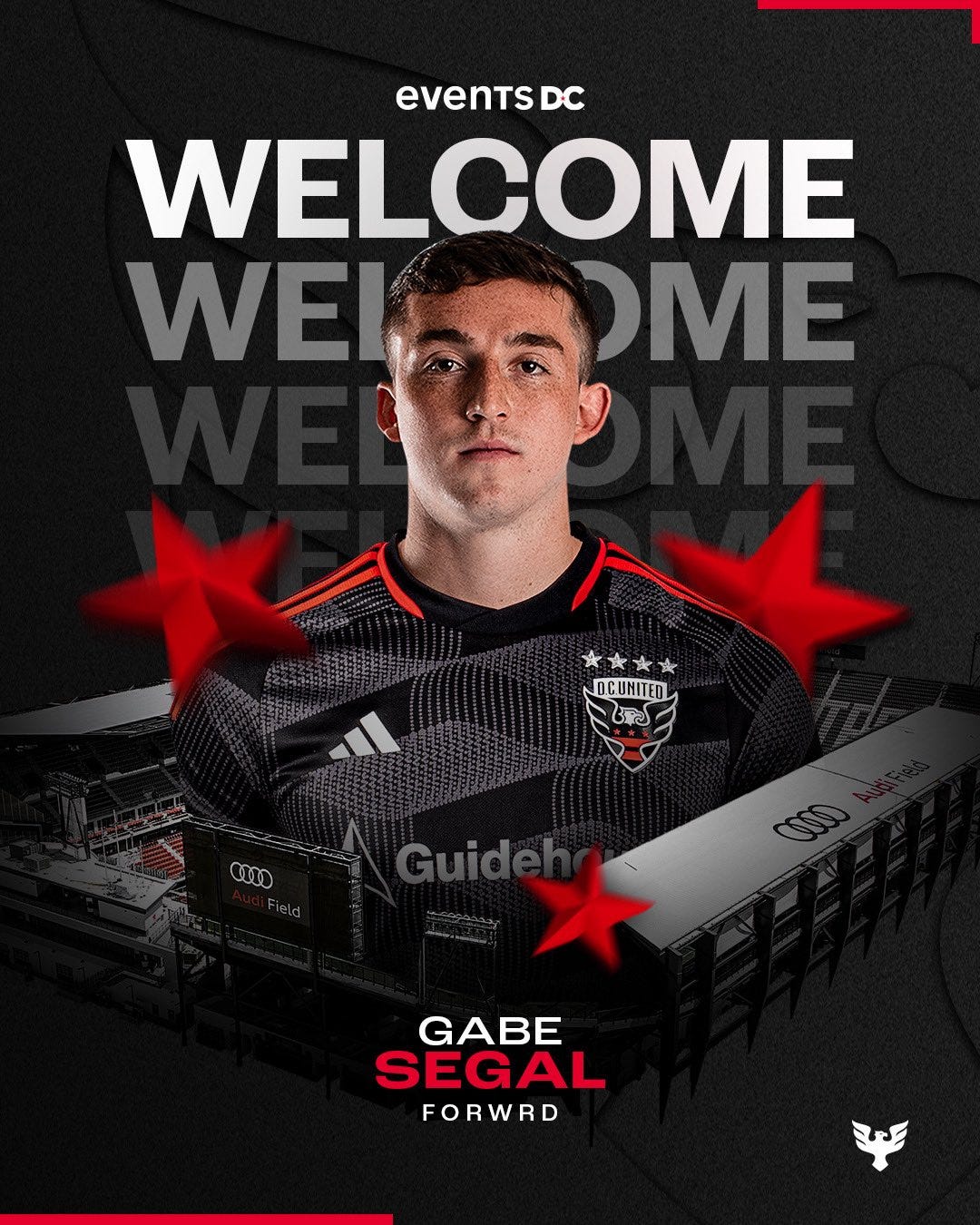
Only two teams made selections in the re-entry draft, but one of them was DC United. What is the re-entry draft, you ask? Ugh, let’s just say it’s the dumb alternative to free agency that the league forces on inexperienced players who are out of contract. Inexperienced and out of contract is not a promising pool of players.
This was the second stage of the draft. The first stage requires the team to actually pick up the contract option, and as usual, absolutely no one wanted to do that. Selecting a player in the second stage merely allows DC to attempt to negotiate a new, lower contract with the player without competing with other MLS teams, but the player can go to any other league at home or abroad.
So when they selected Gabriel Segal, I didn’t pay much attention. DC has selected players before and then not ended up signing them. But in this case, they actually did end up signing him. So…uh…who is this guy, anyway?
He’s a 24-year-old American forward. He grew up in Maryland and as a youth player way back in 2019 he actually made one appearance for Loudoun United. So it’s not shocking he’s ended up at DC United, but he sure went on a circuitous path to get to this point:
He went to Stanford and played three seasons there
Then signed with FC Koln in the Bundesliga, but in practice he played for their academy team in the German fourth division
Then he signed with NYCFC and made 10 MLS appearances
He went on very brief loan to Israel
NYCFC traded him to Houston for a third round draft pick (e.g. absolutely nothing)
He made 24 appearances for Houston, mostly a minute or two in stoppage time
His end of year contract option wasn’t picked up
Segal made $104K, only a little bit north of MLS’ minimum wage. It’s possible that contract option came with a small raise, but Houston not picking up his option is basically saying they didn’t see a use for him despite a minimal cap hit.
For the most part, going to college and then leading an itinerant lifestyle is part and parcel of the just-clinging-to-MLS player, someone who might be less charitably called a “warm body”. Miguel Berry is the past DC player who comes to mind. If you’ve forgotten, Berry scored 8 goals in limited action for Columbus in 2021, genuinely impressive, but has never scored more than two goals in a season since then, and has played for DC, Atlanta, and LA in that time.
“Gabriel is talented young forward, having played three seasons in Major League Soccer and representing the United States Youth National Team,” was all the press release could quote Sogut as saying about him. “He gives our team additional depth.” Okay. No attempt to say he fits into DC’s playing style or has any notable attributes at all. DC’s medical team took his temperature and concluded his body is, in fact, warm.
I’ve gone into this much detail on Segal being an end-of-bencher in order to try to balance out what I’m about to say. In his three MLS seasons, he has two goals in each of them, but has played so few minutes that his goal/90 numbers are…extremely good! 0.43 in 2023 with NYCFC, then 0.89 and 1.17 for Houston. 1.17 is a truly eye-watering number. For reference, Lionel Messi’s goals per 90 was 1.08. LAFC’s Son Heung-min had 1.01. Christian Benteke led DC United with 0.43.
Okay, okay, that 1.17 includes a penalty and I prefer non-penalty goal stats. Take out the penalty and it’s just 0.53. Still better than Benteke, and he hasn’t taken any other penalties so that 0.89 from 2024 doesn’t change. Obviously the sample size here is tiny: Segal played 4.6, 2.2. and just 1.7 games’ worth of minutes in those seasons in 10, 13, and 11 appearances. So he’s mostly getting one minute at the end of the game, plus the odd start here and there (4, 2, and 1 start each season). His one start last season was where he got both of his goals, actually.
Anyway, all of this is just sample size goofiness. Along with Segal there were 8 other guys last season who also had a higher G/90 than Messi, all with very limited minutes. And even worse, one of those 2024 goals was against a team with a notoriously bad defense…DC United. Yes, he scored in Houston’s 4-1 victory, in stoppage time with Houston already leading 3-1, just after Matai Akinmboni got sent off, and Benteke had lready gotten sent off earlier so Houston was up two men.
So in spite of all that, the most salient fact here is that Houston was watching Segal up close and didn’t think he was worth a roster slot. He’s just a warm body, despite posting three good G/90 seasons.
The real implications of this…yes, I am still talking about this reserve player…is for the other reserve attackers on DC United’s roster. Why did Sogut go out and get this guy? Or, more likely, why did he spend a frustrating twenty-five minutes listening to Dave Kasper explaining what the hell a re-entry draft is and then another two minutes about how DC should get this guy and finally say “fine, whatever”?
Waiving Dominique Badji is one part of the answer. Segal’s only 24 but has three seasons of experience, so maybe he counts as “veteran depth”. But I wonder if they’re expecting to loan out Murrell and Karamoko and wanted to have someone who could do spot duty without recalling them. Segal is also 5’10”, so physically he might be a better match for replacing Tai Baribo or Louis Munteanu than at least Murrell, who despite being terrible in aerial duels so far in his career is 6’3”.
The Current Roster
So what might all this actually look like on the field?
Anything could happen, but given the moves so far and the way teams like this have historically played, I’m expecting a 4-2-2-2. There are a bunch of players who theoretically can slot into different roles, but here’s how I see their natural positions:
Goalkeepers: Sean Johnson, Jordan Farr, Kim Joon Hong
Centerbacks: Sean Nealis, Kye Rowles, Jacob Bartlett, Garrison Tubbs, Nikola Markovic
Fullbacks: Aaron Herrera, Keisuke Kurokawa, Conor Antley
Central Midfielders: Matti Peltola, Brandon Servania, Hosei Kijima
Wide Midfielders: Peglow, Caden Clark, Jared Stroud, Richie Aman, Gavin Turner, Oscar Avilez
Forwards: Tai Baribo, Louis Munteanu, Gabriel Pirani, Jackson Hopkins, Jacob Murrell, Hakim Karamoko
From that, here’s my attempt at a depth chart, listing starters with the direct backup in parentheses. This is not necessarily my pick for the most talented players, but how I think Weiler would see things:
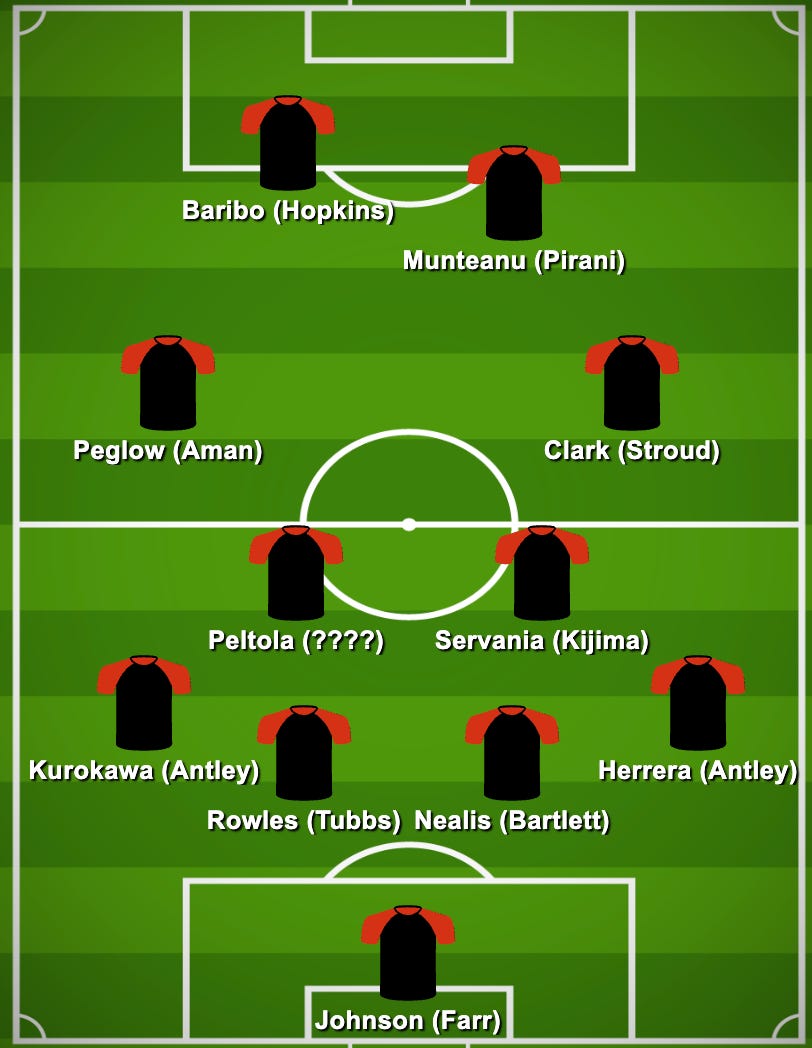
Now let’s address some likely objections.
Yes, Antley is intentionally listed twice. MLS teams often only carry three true fullbacks since other guys can fill in during emergencies (Stroud and Peltola for example).
Also, I remember that under Weiler at the end of last season, Pirani often started over Clark on the right, and Hopkins could add needed depth in midfield, but:
I’m assuming they’re high on Clark (so far I’m not) and he does have the sort of physical attributes one wants for this style of play.
I’ve always rated Pirani, maybe a bit more than he deserves, but athletically he just doesn’t fit a pressing game model and obviously isn’t good enough to be a Messi-style luxury player. Last year his goalscoring was irreplaceable, but this year there’s two expensive forwards who are supposed to be doing that.
I’ve always felt Hopkins is too slow to defend well enough in the midfield where Lesesne always played him. Weiler immediately moved him to forward and suddenly he made much more sense. But then the club spent over ten million on two forwards, so…
If all this is right, the players who aren’t even slotted as a backup are Kim, Markovic, Turner, Avilez, Murrell, Karamoko, and Segal. These are young guys who could and probably should be loaned out since there’s no MLS Next Pro team for them to get minutes, all of them that is except Segal, who as I said above might have been brought in to hold down the fort in the absence of some of these guys. Of course, it would be great if a younger player gets better rapidly and displaces someone from this depth chart!
Anyway, the really glaring gap is in central midfield where with Enow’s departure there are only three players, unless you count Hopkins and Pirani, which I don’t. And with all due respect to Brandon Servania and Hosei Kijima, both of whom I like well enough, what’s needed there isn’t depth but at least one better starter. Even Peltola ought to be nervously following Tom Bogert’s tweets, but two more players here isn’t looking likely, and Peltola did look dramatically better after Weiler took over.
So I’m hoping there’s at least one more signing coming in central midfield. What slots are available? MLS roster rules are pretty complex.
Premium Slots
DC has six “premium” roster slots, either three DPs and three U22s or else two DPs and four U22s. Right now 5 slots are in use since Baribo and Munteanu are DPs and Pirani, Clark, and Kim are U22s.
Using four U22s comes with some extra GAM, so it does have some advantages, but around the league I think the evidence is getting overwhelming that three DPs is the right answer if it’s at all possible. DC looks to have completely whiffed on Kim, but it’s in very good company. Most U22 players haven’t worked out. I believe both the owners and Sogut have made comments saying they expect to have 3 DPs, but like most fans I have been firmly in “I’ll believe it when I see it” territory on that.
Note it’s still possible that Pirani could be sold before the season, or that Kim could depart under circumstances that would free up the slot. If he goes on loan to a Korean team as has been rumored, I don’t think the slot opens, but I could be wrong.
The best way to use U22 slots is to reward young players with a much better contract, since unlike random young players from other countries, they’re a known quantity. If the team is as high on Jackson Hopkins as they have claimed, they have until July of this season to upgrade him to a U22 contract.
International Slots
DC has a natural eight slots and so far I count seven players so far who will need them:
Kim Jong Hoon
Peglow
Matti Peltola
Kye Rowles
Nikola Markovic
Louis Munteanu
Keisuke Kurokawa
Tai Baribo got a green card last season. Peltola really ought to be close to getting his, though Benteke never got one so maybe someone dropped the ball on that paperwork back in the Rooney era.
Of course, despite fans annually fretting over international slots, it seems relatively easy to trade GAM for more as many international slots as desired. Just look at Inter Miami.
Roster Categories
MLS teams can have about 10 players on what’s called the supplemental roster, reserve players who earn less than a certain salary. There are eight carry-overs from last year: Jordan Farr, Jackson Hopkins, Hakim Karamoko, Hosei Kijima, Jacob Murrell, Garrison Tubbs, Gavin Turner, and Oscar Avilez. Add on the two draft picks, Nikola Markovic and Richie Aman, and it’s a full ten players. Except then you also add Gabe Segal and we’re at 11 and someone’s got to go. There are various mechanisms that could enable that to happen, like doing a season-long loan for one of the players to put them in “slot #31”. The really young guys (Karamoko, Turner, and Avilez) would likely all benefit from something like that. Someone could also just get a senior team slot, like Hopkins if he gets a U22 contract.
Note there are no slots available for the three players DC took in the draft after the first round. If there’s a good reason to sign one or more of them, it could happen, but moves would be needed.
For the senior roster, there are 20 slots. The ten carry-overs are Kim Joon Hong, Kye Rowles, Lucas Bartlett, Aaron Herrera, Conner Antley, Matti Peltola, Brandon Servania, Gabriel Pirani, Peglow, Caden Clark, and Jared Stroud. To them, DC has added Tai Baribo, Louis Munteanu, Sean Nealis, Sean Johnson, and Keisuke Kurokawa, bringing them to 16. Most MLS teams don’t use every slot, and when meeting with supporters apparently Sogut said something to the effect that they don’t expect to either.
Remaining Wishlist
First and foremost, a third Designated Player signing. Why not, it’s not our money! My preference would be for a creative central midfielder who can also cover a ton of ground on defense. That would be, uh, a real unicorn, but hey, we’re making wishes here.
But one way or another, the central midfield needs an upgrade. Every other position group has been (at least theoretically) improved: goalkeeper, fullback, centerbacks, and forwards. Even the wide midfielder/winger group was bolstered, maybe, by drafting Richie Aman. Improving the midfield will complete the revamp. Fingers crossed!
Meanwhile, I’m not sure the exact set of preseason articles I’ll be doing yet. If there’s another DP, he’ll get his own article, and if there are enough other notable moves maybe another roundup. I also anticipate at least one big thematic season preview article and some quick notes on the playoff field in the Eastern Conference. It’s not clear to me if the two Coachella Valley Invitational preseason games will be streamed, but it sure would be nice to have real on-field play to talk about.
Great roundup!
Yes. Thank you! Excited for the season!